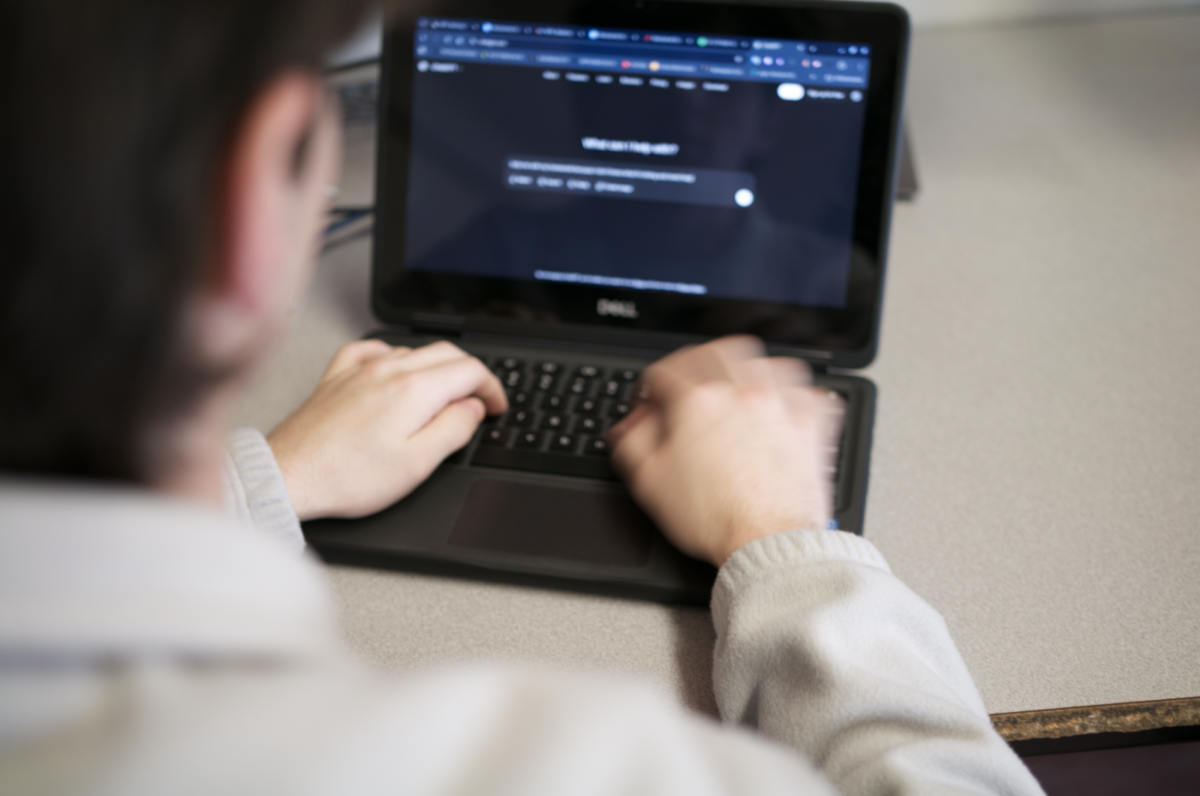
Your favorite movie, that one song you listened to on repeat, and even this school newspaper can all be easily replicated by one prompt. Films, music, and art are slowly being taken over by a much more convenient source—artificial intelligence (AI).
In recent films such as Emilia Pérez and the Brutalist, AI was used to enhance the voices of actors. This alone sparked debates and backlash, but something far more concerning came up in September 2025. A fully AI generated actress, Tilly Norwood, was created. She posts like a real person, talks about her future projects, and various talent agencies have expressed interest in working with her. This fueled huge controversy amongst actors in the film industry, and many people argue that she devalues human actors by training on their work without compensation.
“When I first heard about that actress, I was actually disgusted,” says junior Lily Lambert. “So many people give their whole life to learn the art of acting, and for that to be taken by a computer generated person who can’t feel emotion is crazy.”
If “actors” like Tilly Norwood continue to be created, it will only further diminish the voices of creative people everywhere. The entire purpose of film and art in general is to express ideas and thoughts. A software that doesn’t have the ability to feel anything simply cannot recreate the thought that goes into every movement and emotion that is expressed by actors.
Nobody wants to watch something that has absolutely zero talent put into it. Despite this, big businesses are still going to try and force AI down the throats of the general public; that doesn’t mean we have to accept it. The best way to do this is to boycott movies that use generative AI.
In November 2025, an entirely AI generated English dub was created for the animated series, Banana Fish, by Prime Video. Fans claimed that it was incredibly disrespectful towards the human voice actors and original creators of the show. Less than a week later, this dub was deleted off of Prime as a result of outrage from fans and refusal to watch the new version.
This outcome should be the goal for anything that relies fully on AI for its creation. Soulless AI generated projects will only be produced if they receive positive feedback from the public, which is why humans need to come together and support other humans.
“AI can try its best to replicate human art, but it’ll never be able to replace it,” Lambert said.
However, this does not mean that all AI use is bad. Traditional AI systems are beneficial and have been used since the mid 1900’s to analyze data and identify patterns. Generative AI like ChatGPT, Microsoft Copilot, and Google Gemini are the type of things that people need to be worried about.
The problem with generative AI specifically is that it is constantly training itself to become “more human,” by stealing existing art made by real people, most of the time without permission or payment. Its job is to copy the patterns it sees in human behavior. People have already begun to realize that they can no longer tell the difference between real videos and AI generated ones. This is a huge issue not just for art, but for literally everything. If people can’t tell what’s real and what’s fake, it will be incredibly easy to spread lies to a large audience on social media.
Katelyn Bensen, an art teacher at Bay Shore High School, pointed out that it is no longer obvious when a video is AI generated.
“Its almost hard to answer how often I see it [artificial intelligence] because I don’t always know. Maybe a year ago you’d be like, ‘that video didn’t look right,’ or ‘there’s some weird glitching and it’s probably AI,’ but I think it’s becoming harder to see and that will only continue,” Bensen said.
She also sheds light on the possibility that news sources and media outlets could very easily become untrustworthy once AI reaches a certain point.
“People won’t know where to go for information, and I think that that’s an issue too. People don’t trust that what they’re looking at is real and there’s constant questioning. I think everything becomes a little murky,” Bensen said.
Artificial intelligence may seem like the best option from a business standpoint, because typing in a prompt and getting results in seconds is obviously much cheaper and more efficient than hiring an actual artist. A familiar example of this might be the photos of marauders plastered across the hallways of Bay Shore High School that are reminiscent of AI generated content, even though there are many students who would be willing to create and get their work out there.
Using AI like this can allow companies to generate logos and sell products with AI generated designs. Being able to make profits or promote a message while doing very little work may seem like a no-brainer—AI is great! Not only that, but technology will be able to rapidly reach new heights.
But is this advancement necessarily a good thing? The hundreds of thousands of people left without jobs surely don’t think so. As of November 2025, AI is expected to replace 300 million jobs and could likely force 14% of all workers globally to change careers by 2030. 14% may not seem like a lot, but that’s equivalent to around 1.1 billion people. Not only is that an insane amount, but 2030 is only a few years away. AI’s acceleration over such a short period of time is very unsettling.
“The point of advancing technology is to make people’s lives easier and better, and if advancing technology is making people lose their jobs, then we’re actually going backwards because that is not at all helping people improve,” states senior Emily Ruggiere. “Humans are real. We have real connection. We add little details that only people can add, that robots can’t replace.”
AI is such a controversial topic because it undoubtedly has both amazing benefits and terrifying potential. Media is the first thing at risk, and the only way to help is by not using AI and not interacting with the things that do. Losing the craft of genuine human art because people can no longer tell what’s real and what’s fake is something that everyone should be concerned about.